
Why Healthy Relationships Can Feel “Boring” After Chaos
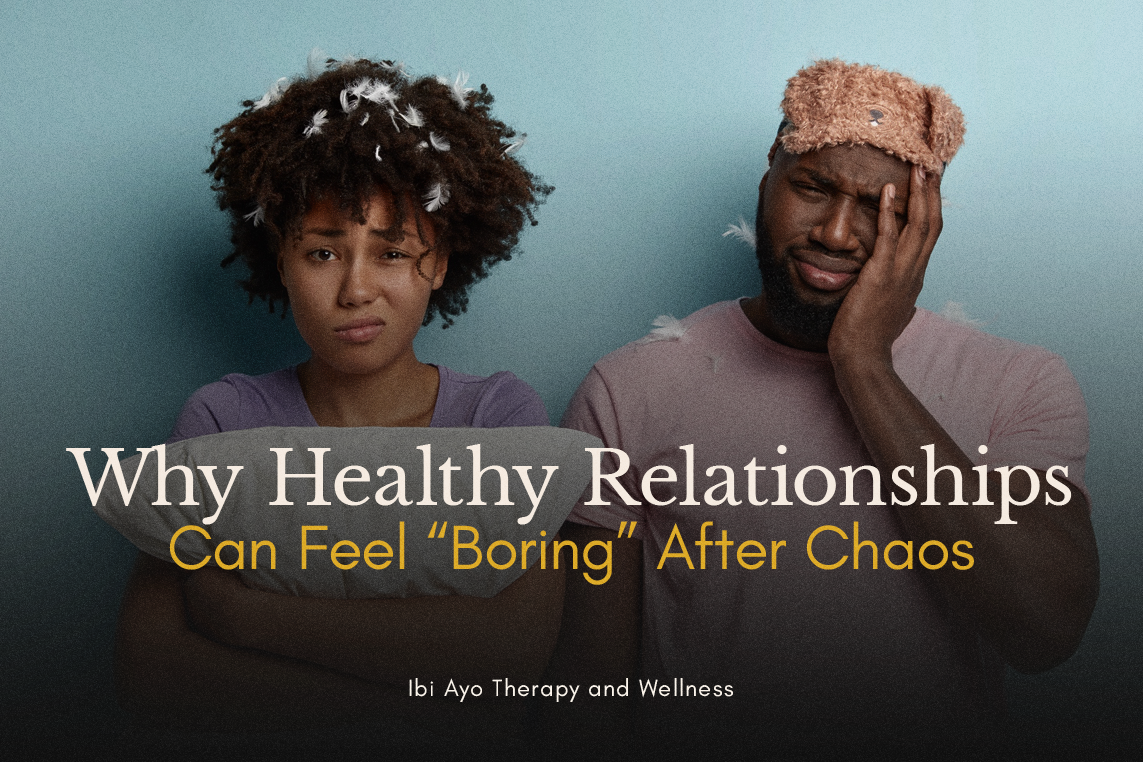
Two years ago, Yewande finally left a relationship that had drained her emotionally.
It wasn't an easy decision. The relationship was filled with mixed signals, arguments, periods of silence, and constant uncertainty. For a long time, she blamed herself for staying. But after it ended, she took time to focus on herself. She went to therapy, leaned on her support system, and slowly began to heal.
Eventually, she felt ready to date again. That's when she met Toni.
Toni was kind, patient, and emotionally available. He communicated openly, respected her boundaries, and consistently showed up for her. There were no games, no confusing signals, and no dramatic arguments. He was everything she had once wished for in a partner.
So why was she bored?
The more time they spent together, the more Yewande found herself wondering if something was missing. She wasn't anxious. She wasn't constantly checking her phone. She wasn't trying to decode mixed messages. Everything was going well, yet she couldn't shake the feeling that the relationship lacked excitement.
What Yewande didn't realize was that sometimes, after spending a long time in chaos, peace can feel unfamiliar and even uncomfortable.
And when peace feels unfamiliar, it's easy to mistake it for boredom.
When Chaos Starts to Feel Familiar
If you've spent years in relationships filled with uncertainty, conflict, mixed signals, emotional highs and lows, or inconsistent affection, your nervous system may begin to associate those experiences with love and connection.
You may become accustomed to wondering:
Do they still like me?
Why haven't they replied?
Are we okay?
Will we argue again?
While these experiences can be emotionally exhausting, they also create a constant sense of anticipation and vigilance.
When that unpredictability disappears, the absence of drama can feel strange.
Mistaking Anxiety for Chemistry
Many people describe feeling an intense "spark" with partners who are emotionally unavailable or inconsistent.
What they sometimes don't realize is that the spark may actually be anxiety.
Uncertainty naturally creates heightened emotional arousal. Your attention becomes focused on the other person. You think about them constantly. Every text message feels significant. Every conflict feels urgent.
This intensity can be mistaken for deep compatibility or passion.
By contrast, healthy relationships often feel calmer. Communication is more predictable. Needs are discussed openly. There are fewer emotional emergencies.
To someone accustomed to chaos, this calmness can initially feel underwhelming.
The Highs Feel Different Without the Lows
Chaotic relationships often operate on extremes.
An emotional apology may follow a painful argument. Periods of distance may be followed by intense affection. Hurt may be followed by reconciliation.
These dramatic shifts can create powerful emotional highs.
Healthy relationships tend to be more consistent. Affection is not something you have to earn after conflict. Safety is not periodically withdrawn and restored.
As a result, the emotional experience may feel less intense, even though it is often more sustainable.
When Stability Feels Unfamiliar
Often the issue is not that healthy relationships are boring- it's that they are unfamiliar.
If you grew up in an environment where love was inconsistent, criticism was common, or emotional needs were not always met, stability may not feel natural.
You may find yourself waiting for something to go wrong, or questioning whether the relationship is "missing something."
You may even feel tempted to create conflict simply because peace feels uncomfortable or strange.
This does not mean there is a problem with the relationship. It may simply mean that your nervous system is adjusting to a different experience of connection.
Learning to Appreciate Healthy Love
One of the most challenging parts of healing is learning that love does not always have to feel dramatic.
Sometimes love looks like:
Consistent communication
Respectful disagreement
Reliability
Emotional safety
Mutual effort
Trust
These qualities may not produce the same emotional rush as chaos, but they often create something more valuable: security.
Over time, many people find that what once felt boring begins to feel peaceful.
Healthy Does Not Mean Boring
If a healthy relationship feels less exciting than previous relationships, it does not automatically mean that something is missing.
It usually means you are adjusting to a version of love that does not require constant anxiety, uncertainty, or emotional survival.
Learning to feel safe can be an adjustment, and learning to trust consistency can take time.
And learning to recognize peace as something valuable rather than something boring is often part of the healing process itself.
Ready to Begin Your Wellness Journey?
Healing from past relationship patterns is deeply personal work, and you don't have to do it alone. If this resonated with you and you're interested in starting your wellness journey, you can fill out our onboarding form to get started. We'd love to support you.
References
Dutton, D. G., & Painter, S. (1993). Emotional attachments in abusive relationships: A test of traumatic bonding theory. Violence and Victims, 8(2), 105–120.
EFPSA Research Pulse. (2026). From Relational Insecurity to Emotional Vulnerability: Attachment and Adult Psychopathology.
Liberty University Digital Commons. Attachment Theory in Adult Romantic Relationships.
Mikulincer, M., & Shaver, P. R. (2007). Attachment in Adulthood: Structure, Dynamics, and Change. Guilford Press.
Psychology Today. (2024). Trauma Bonding.RegulateCo. (2024). Nervous System Healing in Relationships: Co-Regulation and Other Strategies.
Therapy Group of DC. (2025). Healing After Toxic Relationships.