
Trauma Bonding vs Genuine Connection: How to Tell the Difference
Trauma Bonding vs Genuine Connection: How to Tell the Difference
Not every intense connection is a healthy one, and not every quiet love is a weak one.
We've all heard someone say, "We just have this intense connection" about a relationship that, from the outside, looks nothing like love.
Trauma bonds can feel identical to deep love. The longing and the need to be near someone, it's all there. And that's exactly what makes them so hard to leave, and so easy to mistake for the real thing.
This is less about labelling your relationship or judging the people in it. It's about helping you see clearly, because clarity is almost always where healing begins.
What exactly is a trauma bond?
Trauma bonding is a psychological phenomenon where a person develops a deep emotional attachment to someone who causes them harm. It arose under two specific conditions: a significant power imbalance and intermittent cycles of abuse and affection.
The cycle typically looks like this:
tension builds → a painful incident occurs → a period of calm or affection follows.
That relief from the making up triggers a release of dopamine in the brain. The same chemical associated with reward and genuine love. Over time, your nervous system learns to associate the relief of chaos ending with the feeling of being loved.
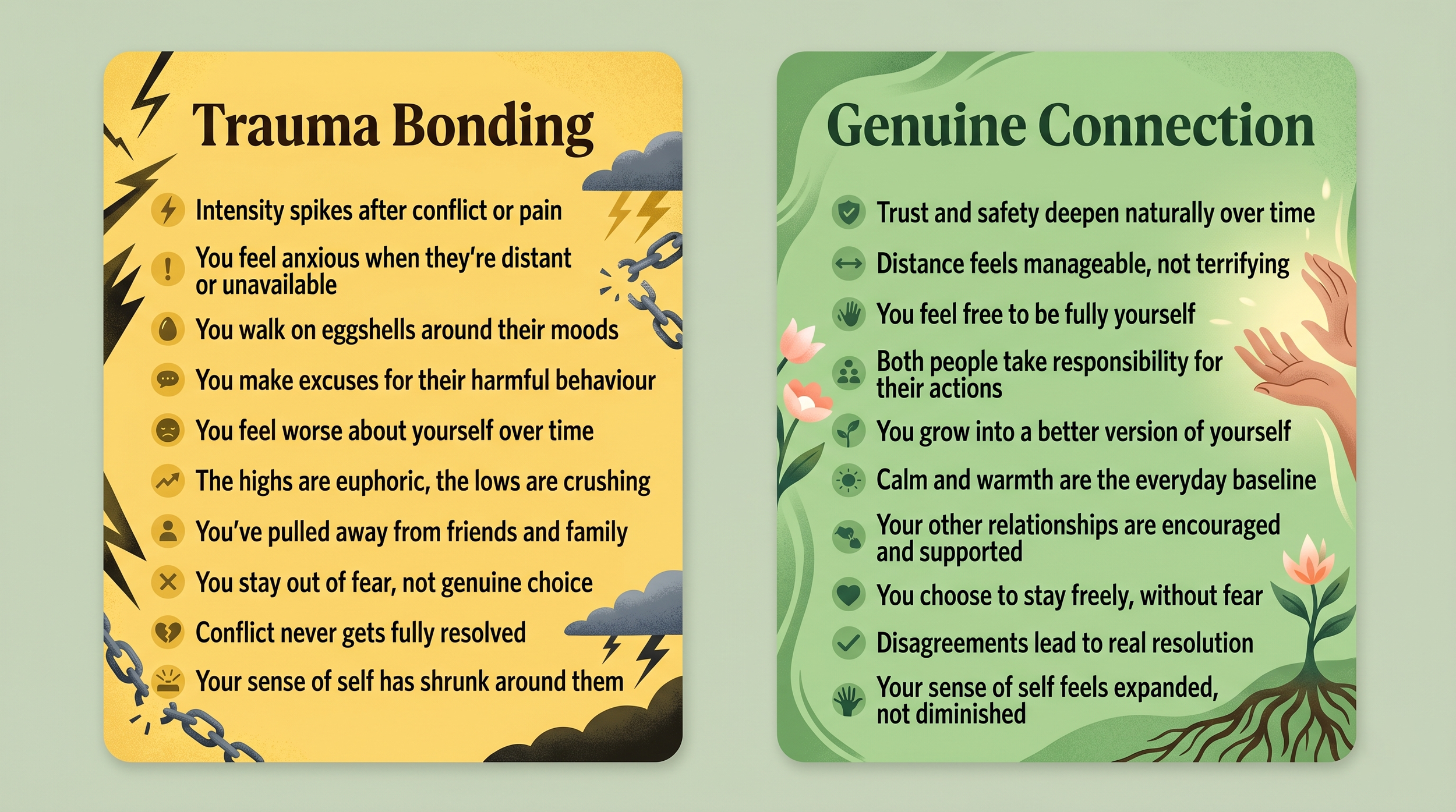
What does each one actually look like?
Questions worth sitting with
There are no right or wrong answers here. These questions are simply invitations to be honest with yourself.
Do I feel more like myself around this person or less?
Is the love consistent, or does it mainly show up after hurt
Am I staying because I want to or because I'm afraid of what leaving means?
Can I express my needs and feelings without fearing a reaction?
Have I drifted away from friends or family because of this relationship?
Do I feel energized or drained after spending time with them
Would I want someone I deeply love to be in a relationship like this?
When things are good, is it because things are genuinely good or because a bad moment just passed?
If some of this felt familiar
Recognizing a trauma bond is a profound act of courage. But naming it rarely means simply walking away. Trauma bonds are psychologically powerful, and breaking free usually requires more than willpower alone. Here are some meaningful steps forward:
Name what you're experiencing, without shame Acknowledging "this might be a trauma bond" isn't an accusation. It's clarity. And clarity is power.
Rebuild your external connections Isolation strengthens trauma bonds. Even one trusted friendship or family relationship can begin to shift the balance.
Learn to recognize the cycle in real time Tension → incident → reconciliation. When you can name the stage you're in, you take back some of the power the cycle holds over you.
Seek trauma-informed professional support Approaches like EMDR, somatic therapy, and attachment-focused counselling work at the root level, not just the surface. You don't have to figure this out alone.
Be patient and gentle with yourself Healing from a trauma bond isn't linear. Some days will feel like setbacks. That's the nature of deep healing.
You deserve a love that doesn't cost you yourself. Our therapists provide a safe, affirming, and culturally sensitive space to help you understand your relationship patterns, process past trauma, and build towards the connection you actually deserve.
References
Bowlby, J. (1969). Attachment and Loss, Vol. 1: Attachment. Basic Books.
Bowlby, J. (1988). A Secure Base: Parent–Child Attachment and Healthy Human Development. Basic Books.
Chenneville, T., et al. (2025). Similarities and differences in trauma bonding among young adults in the U.S. and Kenya: Implications for forensic assessment. Behavioural Sciences & the Law.
Dutton, D. G., & Painter, S. L. (1981). Traumatic bonding: The development of emotional attachments in battered women and other relationships of intermittent abuse. Victimology: An International Journal, 6(1–4), 139–155.
Effiong, J. E., Ibeagha, P. N., & Iorfa, S. K. (2022). Traumatic bonding in victims of intimate partner violence is intensified via empathy. Journal of Social and Personal Relationships, 39(9).
Main, M., & Hesse, E. (1990). Parents' unresolved traumatic experiences are related to infant disorganized attachment status. In M. T. Greenberg, D. Cicchetti, & E. M. Cummings (Eds.), Attachment in the Preschool Years (pp. 161–182). University of Chicago Press.
Reid, J. A., Haskell, R. A., Dillahunt-Aspillaga, C., & Thor, J. A. (2013). Contemporary review of empirical and clinical studies of trauma bonding in violent or exploitative relationships. International Journal of Psychology Research, 8(1), 37–73.
Sanchez, R. V., Speck, P. M., & Patrician, P. A. (2019). A concept analysis of trauma coercive bonding in the commercial sexual exploitation of children. Journal of Pediatric Nursing, 46, 48–54.