
Premarital Counselling: Why More Couples Are Doing It Before They Say "I Do"
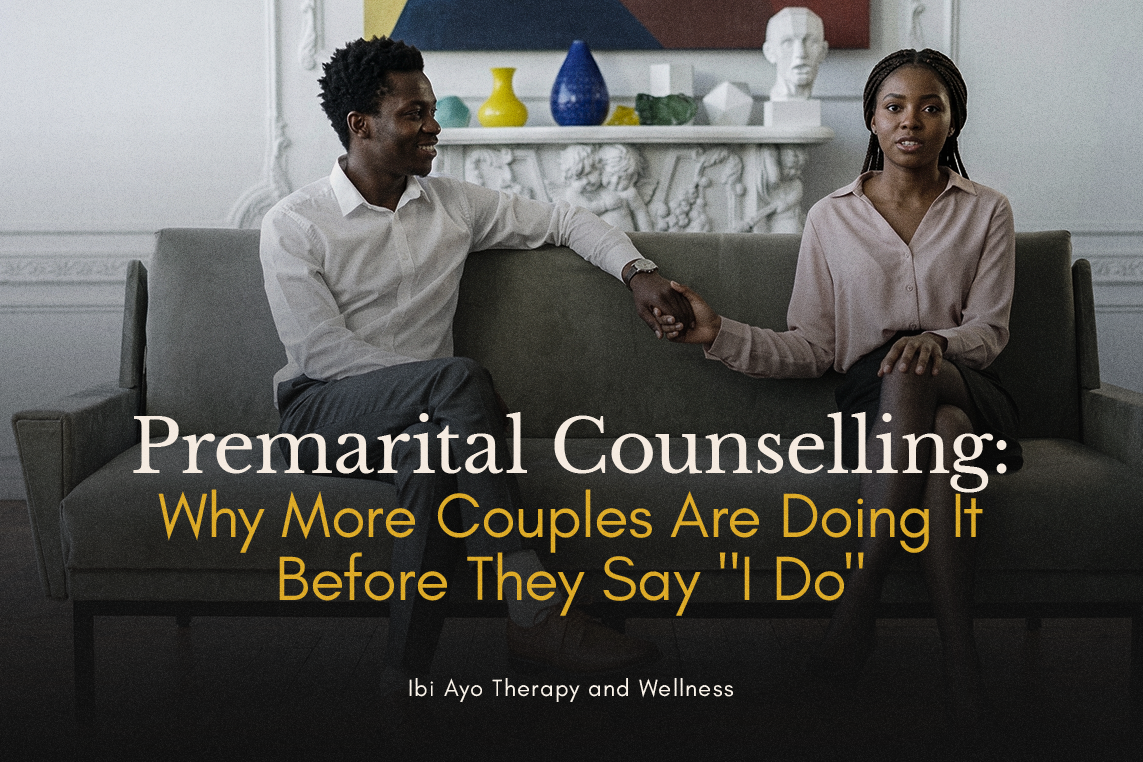
A Candid Conversation About Therapy, Love, and Not Finding Out Too Late
Let me paint you a picture. Two people are deeply in love. They finish each other's sentences, share a Netflix password without drama, and even agree on the thermostat setting, a miracle, honestly. They decide to get married. Everyone claps. The photographer books the venue. And then, six months into matrimony, one person discovers their spouse has been putting the toilet roll on backwards their entire life, and suddenly nothing feels sacred anymore.
Okay, that's a joke. Sort of. But here's the real deal: most couples spend more time planning their wedding than preparing for their marriage. We obsess over table centrepieces, fight over guest lists, and agonize over whether the DJ should play Afrobeats or R&B at the reception, but ask us about how we plan to handle finances, conflict, or in-laws? Crickets.
That's precisely where premarital counselling quietly walks in, clears its throat, and says: "Actually, shall we talk about that?"
Wait, Counselling Before Marriage? Are We That Broken?
This is usually the first reaction. And honestly, it's understandable. In many of our cultures, especially here in Nigeria and across Africa, the idea of seeing a therapist before marriage carries an unspoken (and completely unfair) suggestion that something is already wrong with you, your partner, or your union.
But premarital counselling isn't crisis management. It's not an emergency room. It's more like a pre-flight checklist. You wouldn't board a plane and hope the pilots just "wing it." So why would you enter one of the most significant commitments of your life without a single deliberate conversation about what lies ahead?
Research supports this. Studies show that couples who participate in premarital education programmes report significantly higher marital satisfaction and lower rates of conflict in the early years of marriage (Carroll & Doherty, 2003).
Thriving couples aren't those without problems; they're the ones who learned how to navigate them before the problems became the whole story.
So What Actually Happens in These Sessions?
Contrary to what many imagine, two people sitting across from a stern stranger while someone takes notes on their childhood trauma, premarital counselling is mostly guided, intentional conversation. A good counsellor creates space for couples to explore:
Communication styles: Are you a talker or a stewer? Does silence after a fight mean peace or punishment?
Finances: Joint account or separate? What does "saving" even mean to each of you? Who pays what?
Family and in-laws: How involved will parents be? What do Sunday visits look like? (Very important question, by the way.)
Children and parenting philosophies: Do you want them? How many? What values will you raise them with?
Conflict resolution: Do you fight fair, or do you go for the jugular and then apologize later with jollof rice?
Intimacy and expectations: Both emotional and physical. Yes, these conversations are necessary.
Spiritual and religious alignment: How faith, or the absence of it, will shape your home.
These aren't questions marriage magically answers on its own. And they don't become easier to navigate after the wedding; if anything, the stakes get higher.
A well-known premarital assessment tool, PREPARE/ENRICH, has been used with over 4 million couples worldwide and consistently shows that structured premarital counselling reduces the risk of divorce by up to 30% (Olson & Olson,
Why More Couples Are Actually Doing It Now
Something has shifted, quietly, beautifully, in how a new generation thinks about love. The same millennials and Gen Zs who grew up watching marriages fall apart around them (and memed about it to cope) are now approaching their own unions with a kind of intentionality that's genuinely refreshing.
There are a few reasons the tide is turning:
The destigmatization of therapy: Seeing a professional to talk about your life is no longer a confession of weakness. It's increasingly understood as wisdom.
Social media, ironically: As much as it peddles unrealistic relationship goals, it has also surfaced enough "we should have talked about this before the wedding" stories to scare people into preparation.
Religious organizations: Many churches and mosques have long mandated some form of premarital preparation. Couples who might not seek secular counselling are getting it through this channel and finding it valuable.
The financial stakes are higher: Marriage today involves merging far more complex financial realities than previous generations. Debt, investments, business ownership, and money conversations can't be avoided.
Simply: people want their marriages to actually work. Not just survive. Work.
But We Already Talk About Everything!
Beautiful. Genuinely. But here's a gentle challenge: talking is not the same as being guided through a structured, unbiased exploration of your relationship.
When you talk to each other, you're both emotionally invested. You might avoid certain topics to keep the peace. You might assume you agree on something because you've never actually disagreed on it out loud.
A skilled counsellor asks the questions you never thought to ask, surfaces the assumptions you didn't know you were carrying, and gives you a safe container to work through discomfort, before that discomfort becomes resentment.
Gottman and Silver (1999) found that couples who were able to discuss their differences openly, especially about money, household roles, and family, were far more likely to maintain long-term relationship satisfaction. The research is clear: the quality of conversation before marriage shapes the quality of the marriage itself. Also, let's be honest: some of us think we've discussed finances, but what we've actually discussed is "I like to save, and you like to spend, and isn't that funny ha ha", without ever building an actual plan. That's not a conversation. That's a debt waiting to happen.
So, Should You Do It?
If you're engaged, seriously considering it, or just deeply in love and wanting to stay that way, yes. Absolutely yes. Not because your relationship is in trouble, but because it deserves the same care and preparation you'd give anything else you truly value.
Book the sessions. Have the hard conversations. Laugh through the awkward ones. Find out now that your partner thinks a "budget" is just a suggestion, or that their vision of "quality family time" involves the entire extended family moving in for the holidays.
Find out now, while you still have time to negotiate, to understand, to choose each other with full information.
Because that's what real love does. It doesn't just feel. It prepares.
A marriage built on intention is a marriage built on something real. Premarital counselling isn't about fixing what's broken; it's about fortifying what's already good. Consider it the foundation, not the furniture.
Start Your Journey at Ibi Ayo Therapy & Wellness
At Ibi Ayo Therapy & Wellness, we believe that every couple deserves a safe, warm, and professionally guided space to do this important work. Our therapists understand the cultural, relational, and personal nuances that shape Nigerian couples and families, and we're here to walk this path with you.
Ready to begin?Fill Out Our Onboarding Form
Your First step toward a relationship built on intention.
References
Carroll, J. S., & Doherty, W. J. (2003). Evaluating the effectiveness of premarital prevention programs: A meta-analytic review of outcome research. Family Relations, 52(2), 105–118.
Gottman, J. M., & Silver, N. (1999). The seven principles for making marriage work. Crown Publishers.
Markman, H. J., Rhoades, G. K., Stanley, S. M., Ragan, E. P., & Whitton, S. W. (2010). The premarital communication roots of marital distress and divorce: The first five years of marriage. Journal of Family Psychology, 24(3), 289–298.
Olson, D. H., & Olson, A. K. (2000). Empowering couples: Building on your strengths. Life Innovations.
Stanley, S. M., Amato, P. R., Johnson, C. A., & Markman, H. J. (2006). Premarital education, marital quality, and marital stability: Findings from a large, random household survey. Journal of Family Psychology, 20(1), 117–126.