
Is Absence a Form of Love? Exploring Father-Child Relationships Through My Father’s Shadow
“Absence makes the heart grow fonder.” Thomas Haynes Bayly
Although it is a beautiful sentiment, when it comes to a father who was never in the room, does the heart really grow fonder, or does it simply learn how to live without expecting anyone to stay?
Many of us grew up with fathers who were physically present but emotionally distant, or fathers who were absent altogether. Somewhere between childhood and adulthood, we accepted it as normal.
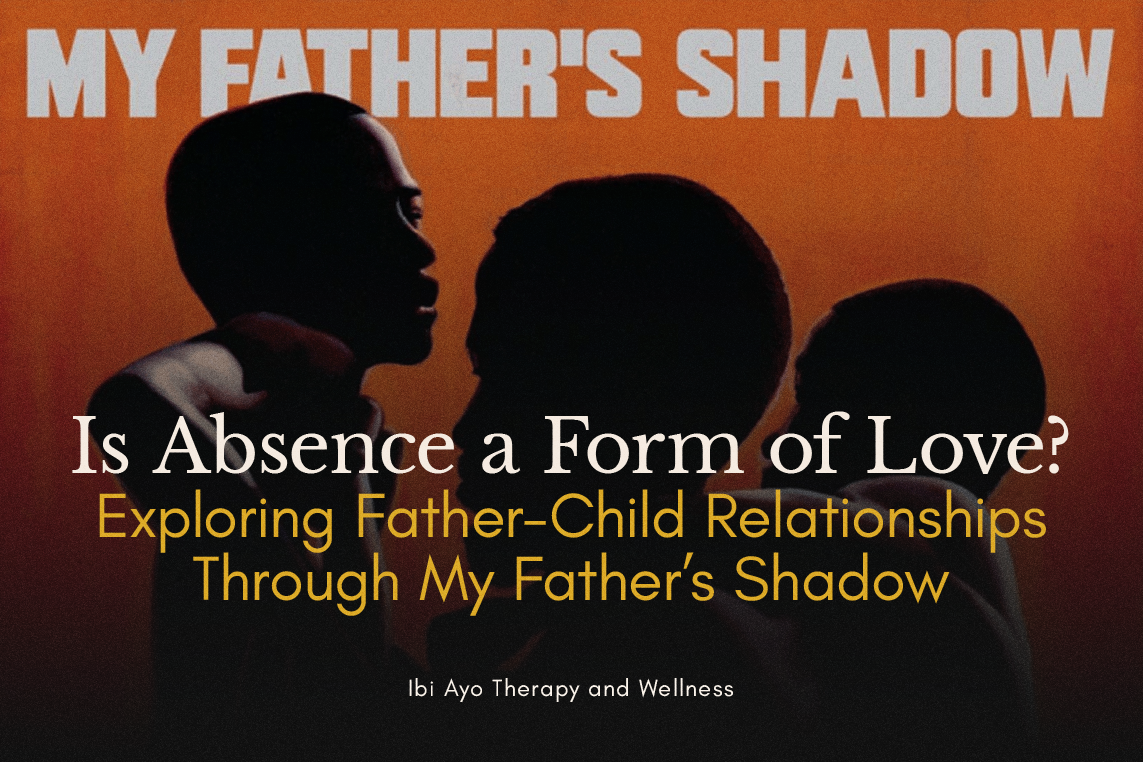
But My Father's Shadow invites us to look at those questions again.
The Question at the Heart of the Film
One of the most moving moments in My Father's Shadow comes when the protagonist's son confronts him:
"Why are you never around?"
The father replies: "I have to work."
And then comes the question that lingers long after the scene ends: "Why couldn't you find a job closer to home?"
What might seem like a simple question is a hint to something much deeper.
It’s a child asking: Did you choose to be far from me? And if so, what does that say about how much I matter?
Children rarely understand absence through the lens of responsibility or financial pressure.
And when someone important is consistently absent, they often wonder whether that absence says something about their worth.
What Does Absence Really Look Like?
Absence in father-child relationships shows up in different ways. It is not always about a father who left. Sometimes it looks like:
A father who is physically present but emotionally unavailable
A father who works constantly and is rarely home
A father who never asks how you're doing
A father who struggles to express affection or vulnerability
A father who only appears during milestones but misses everyday moments
A father who withdraws during conflict or difficult seasons
In each case, the experience for the child can feel remarkably similar: a longing for connection that never quite gets met.
Was It Still Love?
Many fathers may genuinely love their children but are simply repeating what they learned from their own fathers.
A father may believe, "Everything I'm doing is for my family."
A child may experience, "My father is never here."
Both realities can exist at the same time.
The Lasting Impact of Father Absence
BResearch shows that paternal absence, whether physical or emotional, can have lasting effects on a child's emotional wellbeing and relationships.
Some of the most common effects include:
Difficulty trusting others or forming secure attachments
A persistent sense of not being “enough” or not being worthy of love
People-pleasing behaviours, always trying to earn approval
Struggles with self-worth and identity, especially in men
Anxiety, depression, or emotional numbness in adulthood
Repeating the same distant patterns in their own relationships or parenting
These are natural responses of a person who grew up learning to survive without something they fundamentally needed.
Healing the Father Wound
Healing asks you to hold both truths and then decide what you need now to move forward.
Your father may have loved you, but his absence may still have hurt you.
Therapy can help create space for both realities. Most importantly, remind you that your story did not end with what you did or did not receive as a child.
Ready to Start Your Healing Journey?
At Ibi Ayo Therapy & Wellness, we provide a warm, culturally responsive space to explore childhood experiences, family relationships, and the lasting impact they can have on your wellbeing.
If this conversation resonates with you, we invite you to take the first step.
Fill Out Our Onboarding Formand begin your therapy journey with us today.
References
Bayly, T. H. (1850). Isle of Beauty. In Songs, Ballads, and Other Poems. London: Richard Bentley. (Source of the quote “Absence makes the heart grow fonder.”)
Brontë, E. (1847). Wuthering Heights. Thomas Cautley Newby.
Cabrera, N. J., Tamis-LeMonda, C. S., Bradley, R. H., Hofferth, S., & Lamb, M. E. (2000). Fatherhood in the twenty-first century. Child Development, 71(1), 127–136.
Coles, R. L. (2009). Just doing what they gotta do: Single Black custodial fathers coping with the stress of poverty and parenting. Journal of Family Issues, 30(10), 1311–1338.
Davies Jr., A. (Director). (2025). My Father's Shadow [Film]. Element Pictures; Fatherland Productions; BBC Film; BFI; Crybaby.
Lamb, M. E. (Ed.). (2010). The Role of the Father in Child Development (5th ed.). John Wiley & Sons.
McLanahan, S., Tach, L., & Schneider, D. (2013). The causal effects of father absence. Annual Review of Sociology, 39, 399–427.
Rohner, R. P., & Veneziano, R. A. (2001). The importance of father love: History and contemporary evidence. Review of General Psychology, 5(4), 382–405.
Siegel, D. J. (2012). The Developing Mind: How Relationships and the Brain Interact to Shape Who We Are (2nd ed.). Guilford Press.
Waldfogel, J., Craigie, T. A., & Brooks-Gunn, J. (2010). Fragile families and child wellbeing. Future of Children, 20(2), 87–112.