
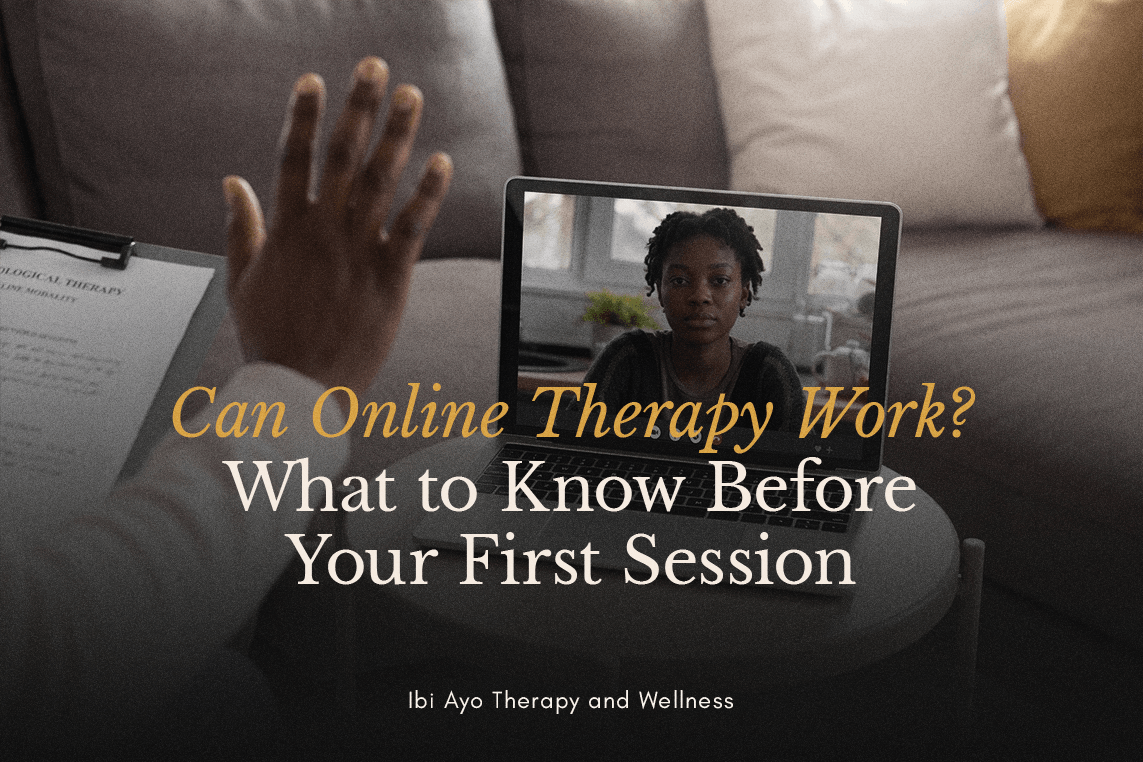
Imagine telling someone that you have finally decided to start therapy. They ask when your appointment is, and you tell them it is on Thursday. Then they ask where the therapist's office is. You say, "I don't have to go anywhere. I'll be seeing them on my laptop."
There is usually a moment of hesitation.
"Wait, you're going to do therapy online? How does that even work?"
For many people, therapy is still associated with sitting in a room with a therapist, having a conversation, and working through personal difficulties.
The idea of doing all of that through a phone or computer can feel strange. Some wonder whether they will be able to connect with their therapist, whether the conversation will feel natural, or whether talking through a screen can genuinely make a difference.
These are reasonable questions, especially if you have never experienced therapy before.
But online therapy is not simply a casual conversation over a video call. It is a form of psychological support delivered through digital communication, usually by a qualified mental health professional.
Depending on the service, sessions may take place through video conferencing or telephone calls. The therapist still listens, asks questions, helps you understand your experiences, and works with you towards meaningful therapeutic goals.
So, can online therapy actually work?
The short answer is yes. Research increasingly suggests that it can.
For many people receiving appropriate treatment, the physical presence of a therapist in the same room is not necessarily what determines whether therapy can be helpful.
It is important, however, to understand what this means. It does not suggest that every mental health concern can be addressed online or that all forms of digital mental health support are equally effective. The quality of care, the therapist's competence, the person's needs, and the suitability of the format all matter.
One of the biggest advantages of online therapy is accessibility.
Consider someone who lives far from a mental health professional, has a demanding work schedule, or finds it difficult to travel regularly for appointments. In-person therapy may be helpful, but getting to the therapist's office can become another challenge to manage. Online sessions can reduce some of these barriers by allowing people to access support from a location that works for them.
It can also offer a greater sense of convenience and flexibility.
Someone who travels frequently or lives in a different city from their preferred therapist may find it easier to maintain consistency with virtual appointments. For some people, beginning therapy from a familiar environment can also make the experience feel less intimidating.
However, convenience is not the only consideration. A common concern about online therapy is whether a meaningful therapeutic relationship can develop through a screen. After all, therapy involves more than exchanging information. It requires trust, openness, understanding, and a sense of safety.
The good news is that a therapeutic relationship does not depend entirely on sharing the same physical space. A therapist can still listen carefully, ask relevant questions, notice changes in communication, and help a client explore difficult experiences during a virtual session. What matters is whether the person feels heard, respected, and understood. If the connection does not feel right, it is also reasonable to discuss those concerns with the therapist.
Of course, online therapy has limitations.
A poor internet connection can interrupt an important conversation. Background noise, interruptions, or a lack of privacy can make it difficult to speak freely. Some people also find it harder to communicate through a screen or prefer the structure and physical presence of an in-person appointment.
There may also be situations where online therapy is not the most appropriate option. A person's circumstances, level of distress, safety needs, or clinical presentation may require more direct or specialised support.
In such situations, a therapist may recommend in-person care, additional services, or a different level of support. Online therapy should not be treated as a replacement for emergency or crisis services.
This brings us to an important question.
How do you know whether online therapy is right for you?
If you are considering your first online session, there are a few things worth knowing before you begin.
First, you do not need to have everything figured out before your first appointment. Many people postpone therapy because they are unsure how to describe their concerns. However, part of the therapist's role is to help you make sense of these experiences.
Your first session may also feel different from what you imagined. You may discuss your background, expectations, confidentiality, session arrangements, and possible goals for therapy. This initial conversation helps the therapist understand your needs and consider how best to support you.
It is equally important to create a suitable environment for your session. Choose a quiet and private space where you can speak without worrying about being overheard or interrupted. Check your internet connection, charge your device, and make sure your camera and microphone are working. Using headphones may also help improve audio quality and privacy. If you are using a shared device or network, consider whether other people can access your session information. Your therapist should explain the technology being used and the relevant privacy arrangements.
It is worth noting that therapy is not a one-session solution. You may leave your first appointment feeling relieved, uncertain, emotional, or with more questions than you initially had. That is not necessarily a sign that something went wrong. Therapy is a collaborative process.
At Ibi Ayo Therapy and Wellness, getting started with virtual therapy involves completing the onboarding form. This helps us understand your needs and match you with the right therapist.
Know This;
Your first online session does not require you to have the right words, a complete understanding of your experiences, or a clear plan for everything you want to change. It simply requires a willingness to begin a conversation.
And sometimes, that conversation is a good place to start.
References
American Psychological Association. (2024). Guidelines for the practice of telepsychology. https://www.apa.org/practice/guidelines/telepsychology
Simmonds-Buckley, M., et al. (2024). Therapist-guided remote versus in-person cognitive behavioural therapy: A systematic review and meta-analysis of randomized controlled trials. CMAJ, 196(10), E327–E340. https://doi.org/10.1503/cmaj.230274
Omylinska-Thurston, J., Aithal, S., Liverpool, S., Clark, R., Moula, Z., Wood, J., Viliardos, L., Rodríguez-Dorans, E., Farish-Edwards, F., Parsons, A., Eisenstadt, M., Bull, M., Dubrow-Marshall, L., Thurston, S., & Karkou, V. (2024). Digital psychotherapies for adults experiencing depressive symptoms: Systematic review and meta-analysis. JMIR Mental Health, 11, e55500. https://doi.org/10.2196/55500