
Pleasure vs. Pain: Why the Things That Feel Good Are Making You Feel Worse
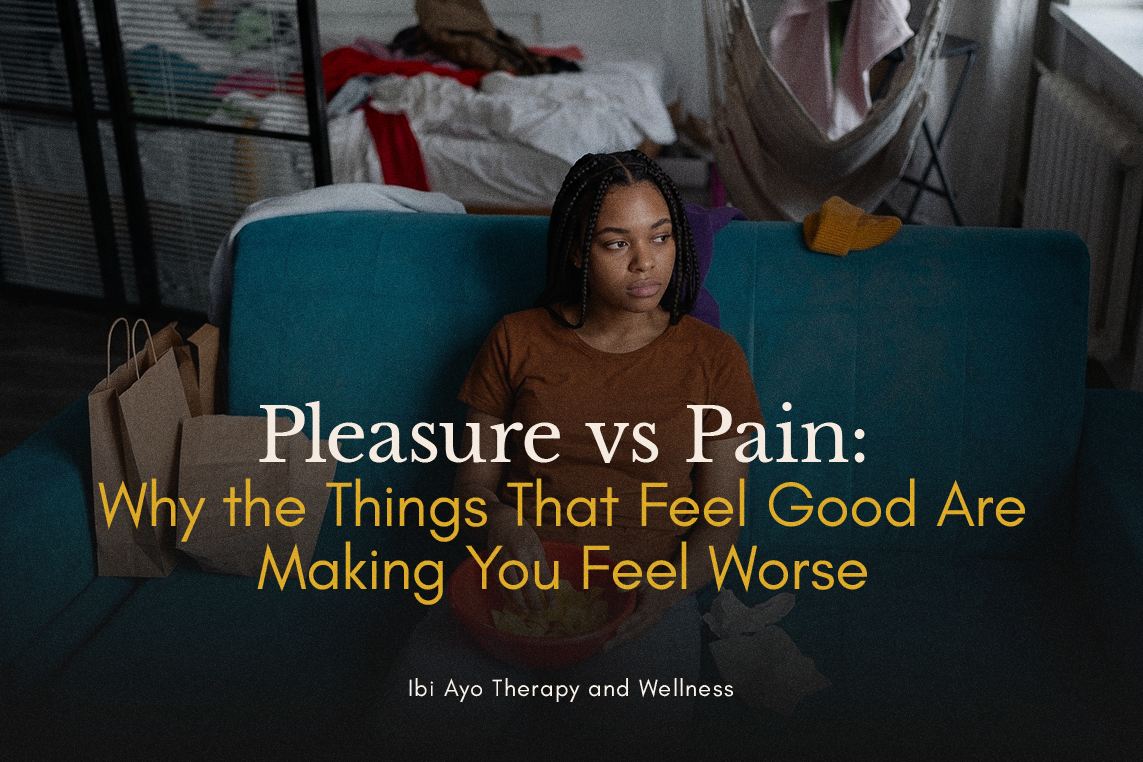
Imagine scrolling through your phone at 11 p.m., not because you want to, but because you can't stop. Another episode plays automatically. The snack bag empties before you noticed you were eating. On the surface, each of these acts is harmless, even pleasurable. But collectively, they describe a pattern that is quietly rewiring the way we feel and suffer.
We live in an era of unparalleled access to pleasure, and yet rates of anxiety, depression, and burnout are climbing. The question worth asking: could our relentless pursuit of what feels good be precisely what is making us feel so bad?
According to neuroscience and addiction medicine, the answer is yes and it begins with a single misunderstood molecule: dopamine.
Your Brain's Hidden Seesaw
Dr. Anna Lembke, a psychiatrist at Stanford and author of the landmark 2021 book Dopamine Nation, frames the problem with a simple image: a seesaw.
Here’s how it works:
Pleasure tips the seesaw
Every time you experience pleasure, your brain releases dopamine.
Your brain fights for balance
The brain immediately fires a counter-response to restore equilibrium.
Dopamine drops afterward
That balancing act suppresses dopamine and nudges you toward discomfort.
This is not metaphor, it is neurochemistry. Research in Nature Reviews Neuroscience shows that pain and pleasure share the same neural substrates, modulated by the same dopamine and opioid systems (Leknes & Tracey, 2008). The circuitry that delivers delight also generates the crash that follows.
The real problem:
The human brain evolved in scarcity.
Dopamine surges were meant to reward rare, effortful wins.
But modern life offers:
Netflix autoplay
Instagram notifications
Engineered junk food
Endless stimulation on demand
That ancient reward system becomes overwhelmed.
The result:
The more intense the stimulus, the stronger the crash.
Over time, your baseline drops.
What once felt joyful now feels ordinary.
What once felt ordinary now feels unbearable.
(Lembke, 2021)
Lembke calls the result the dopamine deficit state, a chronic restlessness that compels you to seek more stimulation not to feel good, but simply to feel normal.
The paradox:
The more we consume,
the less we feel,
and the more we need just to break even.
"We are all at risk of titillating ourselves to death."
Dr. Anna Lembke, Dopamine Nation (2021).
The Bottom Line
Nowhere is the pleasure-pain paradox more visible than in our relationship with digital technology.
Social media platforms are designed to keep you hooked through:
Notifications
Likes
Endless scrolling
Variable rewards
Researchers call this the "magical maybe", a variable-ratio reinforcement schedule, identical in structure to a slot machine.
Why it works so well:
The unpredictability is the point.
Random rewards are more addictive than consistent rewards.
Your brain keeps checking because maybe the next scroll will feel satisfying.
The cruelest detail: we reach for our phones most when we are stressed or sad, precisely when the dopamine deficit state is deepest and doing so deepens it further.
Psychologists describe this as the hedonic treadmill:
We chase pleasure.
We adapt to it quickly.
We need more of it.
We end up emotionally running in place.
(Brickman & Campbell, 1971)
"The reason we're all so miserable may be because we're working so hard to be happy."
Anna Lembke, Dopamine Nation (2021)
Pain as the Path Back
What Lembke proposes is not asceticism, but recalibration.
Examples of voluntary discomfort:
Cold exposure
Fasting
Intense exercise
Deep focus
Delayed gratification
These experiences briefly tip the seesaw toward pain, triggering the brain's counter-response: a genuine dopamine release.
In simple terms:
Short-term discomfort can restore long-term balance.
Lembke advocates a "dopamine fast", a deliberate period of abstinence from whatever has hijacked the seesaw, to allow the brain's baseline to reset.
What many people report afterward:
The world feels vivid again.
Ordinary experiences become enjoyable again.
Simple things begin to feel like enough.
Examples:
Sunlight
Conversation
A simple meal
Quiet moments
Things that had become invisible are suddenly enough.
Finding Balance
None of this is an argument against pleasure.
The goal, as Lembke frames it, is to recover the capacity to feel genuine pleasure from ordinary life, rather than requiring ever-escalating stimulation just to feel anything at all.
That means:
Pressing pause on automatic, effortless consumption.
Sitting with boredom long enough to remember it is not an emergency.
Choosing difficulty sometimes.
Not because comfort is wrong, but because comfort without effort quietly hollows out the capacity for joy.
The Final Truth:
The seesaw is always moving. The question is whether you are its passenger or its pilot.
If any of this feels familiar, you're not alone, and you're not broken. Sometimes the pattern runs deeper than a dopamine fast can reach.
At Ibi Ayo Therapy & Wellness, we work with people navigating anxiety, stress, trauma, and emotional overwhelm, helping you understand what's driving the cycle and find your way back to genuine balance.
Whenever you're ready, you can take the first step here
References
Brickman, P., & Campbell, D. T. (1971). Hedonic relativism and planning the good society. In M. H. Appley (Ed.), Adaptation-level theory (pp. 287–305). Academic Press.
Desch, S., Schweinhardt, P., Seymour, B., Flor, H., & Becker, S. (2023). Evidence for dopaminergic involvement in endogenous modulation of pain relief. eLife, 12, e81436.
Leknes, S., & Tracey, I. (2008). A common neurobiology for pain and pleasure. Nature Reviews Neuroscience, 9(4), 314–320.
Lembke, A. (2021). Dopamine nation: Finding balance in the age of indulgence. Dutton/Penguin Random House.
Primack, B. A., Shensa, A., Escobar-Viera, C. G., Barrett, E. L., Sidani, J. E., Colditz, J. B., & James, A. E. (2017). Use of multiple social media platforms and symptoms of depression and anxiety: A nationally-representative study among U.S. young adults. Computers in Human Behavior, 69, 1–9.
Shahraki, N., Dehesh, T., & Mosleh-Shirazi, M. A. (2022). Social media use and mental health: A global analysis. International Journal of Environmental Research and Public Health, 19(21), 14362.
U.S. Department of Health and Human Services. (2023). Social media and youth mental health: The U.S. Surgeon General's advisory. https://www.hhs.gov/sites/default/files/sg-youth-mental-health-social-media-advisory.pdf