
Navigating Grief in African Culture: When ‘Be Strong’ Isn’t Enough
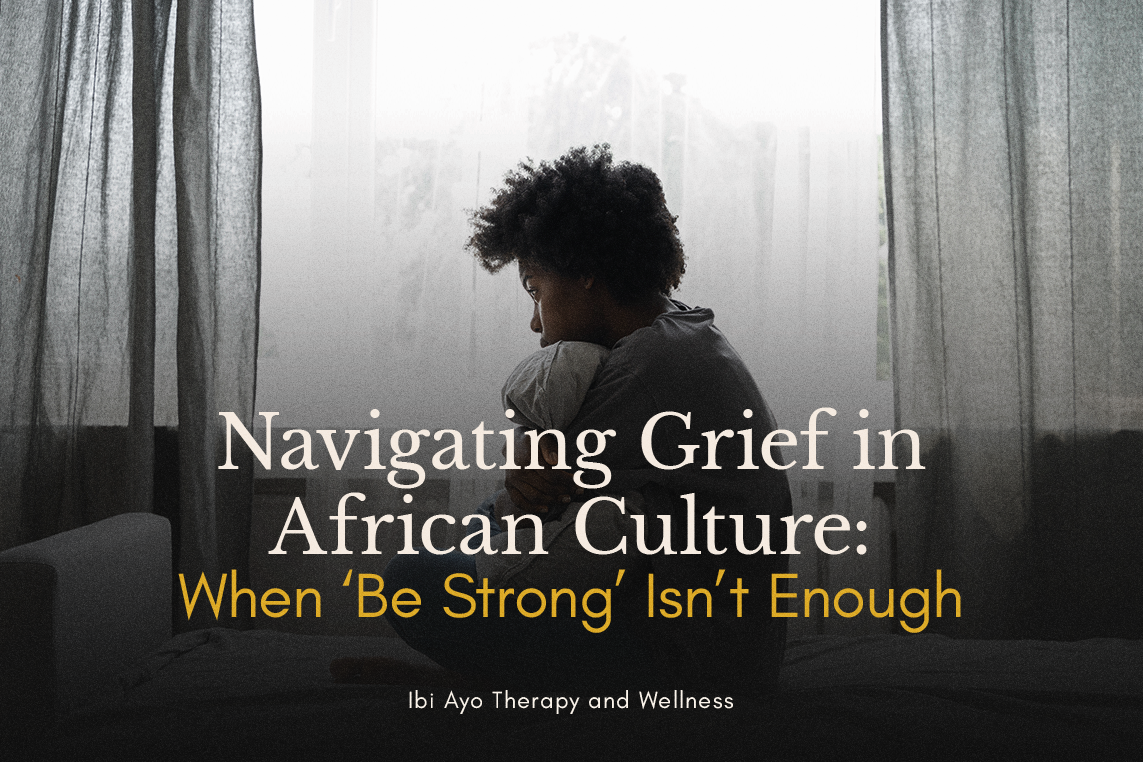
Someone close to you dies. Before you've even had a chance to fully process what's happened, before the reality has settled into your bones, someone is already beside you with a warm smile and a firm hand on your shoulder saying: "Be strong."
And just like that, your grief has been assigned a dress code. Suit up. No crying allowed. Vulnerability: strictly prohibited.
If you grew up in an African household, you don't just know this script; you are this script. You've watched your aunties dry their eyes before walking into a room. You've seen your father nod stoically at the funeral while every muscle in his jaw worked overtime. You've probably said it yourself to someone else, because what else do you say?
But here's the thing nobody tells you: grief doesn't follow the script.
The Strength We Inherited
There is something genuinely beautiful about the African cultural approach to grief. When someone passes, the community shows up, and I mean shows up. Food is cooked. Songs are sung. The extended family you haven't seen since 2009 arrives at your door with rice and strong opinions about how the burial should go. Nobody grieves alone.
This communal holding is sacred. It is a gift that many people from more individualistic cultures quietly envy.
But somewhere inside that beautiful communal web, a quiet message also travels, often unspoken, passed down through generations like a family heirloom nobody chose but everybody keeps:
Grief is acceptable. But too much grief? That's embarrassing.
Cry, yes. But not too loudly. Mourn, yes. But not too long. Feel the loss, yes. But for goodness' sake, by the forty-day prayer, you should be getting yourself together.
"Life Goes On" And Other Things That Don't Help
Let us take a moment to formally acknowledge the greatest hits of African grief commentary:
"Be strong." (For who, exactly? The ancestors? The neighbours?)
"They are in a better place." (Great. I'm still here, though.)
"God knows best." (Theologically sound. Emotionally, not enough.)
"At least they lived a full life." (Cool. Still miss them.)
"Life goes on." (Does it? Does it really? Because mine feels paused.)
These phrases come from love. Nobody is standing at your door trying to cause damage. Your auntie, who says, "wipe those tears, you have to be strong," genuinely believes she is helping you. She learned from her mother, who learned from her mother, across generations of people who survived things we can barely imagine: colonization, displacement, economic hardship, loss upon loss upon loss.
Strength as a survival strategy is deeply rational. When you're surviving, you don't have the luxury of sitting with your feelings. You move.
The problem is that trauma got packed up and passed down along with the strength. And now we're generations deep, inheriting the tools for endurance without being given the tools for healing.
What Happens When We Don't Grieve
Here is what nobody warns you about suppressed grief: it does not disappear. It just goes underground.
It shows up as irritability you can't explain. As the inexplicable sadness that hits in October for no apparent reason. As the way certain songs make your chest feel like a fist is squeezing it. As the numbing, the slow, quiet disconnection from your own feelings that feels like peace but is actually just avoidance wearing a very convincing costume.
Grief is not weakness. Grief is, in fact, love with nowhere to go
When someone or something significant is gone, a person, a relationship, a version of your life you thought you'd have, grief is the appropriate, human, dignified response. Not to grieve would be the strange thing.
And yet, so many of us have been so well-trained that we feel guilty for grieving. We cry in the shower because that's the only place where no one can see us being "weak." We say "I'm fine" until one day, years later, we break down in a supermarket over a brand of tea our late grandmother used to drink, and we have absolutely no idea why.
That's why.
The Specific Grief Nobody Talks About
We should also name the grief that doesn't come with a funeral because African culture is especially silent about this kind:
The grief of a relationship ending: You're not allowed to mourn a breakup for too long. Someone will inevitably say, "It's not like someone died." As if your heart knows the difference.
The grief of a lost opportunity: The scholarship that didn't come through. The business that failed. The career path that closed.
The grief of migration: Leaving home, whether across the country or across the ocean, is its own profound loss. The food, the language on the street, the ease of being known. People migrate and are expected to just adapt without acknowledging what it costs them.
The grief of generational expectations: Growing up carrying the weight of a family's hope is heavy. When you can't deliver or when you choose your own path instead, there is grief in that, too.
All of these deserve space. All of these are real.
But What Do We Do With It?
Glad you asked. Here are some genuinely useful things:
Name what you're feeling.
Sometimes grief doesn't even know it's grief until you call it by name. Journaling, therapy, or even just a long conversation with a trusted person who won't immediately tell you to "be strong," these things help.Find your people, even if it takes effort.
The communal support in African culture can be healing when it has room for honesty. Find the people in your life who can hold space for your real feelings, not just your composed face. They exist. Sometimes they're also quietly waiting for permission to not be fine.Consider therapy, and let's talk about that.
Yes, I said it. Therapy. The word that still makes some African households go quiet. Therapy is not for people who are "mad." It is for people. It is literally a designated space to put down what you've been carrying, with a trained professional who will not tell you to be strong, cook jollof to cover the pain, or suggest you pray harder (though prayer, if that's your thing, is absolutely allowed alongside other healing).
More African therapists are emerging who understand the specific cultural context we carry. Seeking one out can make the process feel less alienating.
Permit yourself to grieve out of season.
Grief doesn't keep to the official mourning schedule. If something surfaces years later, let it. Delayed grief is still grief. You haven't "failed" at healing; you're just finally safe enough to feel it.Honour the ritual, but don't hide in it.
African mourning rituals, the prayers, the gatherings, the songs, can be genuinely healing. Let them hold you. And make sure that underneath the ritual, you are actually feeling, not just performing.
A New Inheritance
The strength our elders passed down to us is real, and it is valuable. It carried them through things we will never fully understand. We honour them by surviving, by thriving, by continuing.
But survival and healing are not the same thing.
What if the next inheritance we pass down, to our children, to our younger siblings, to the next generation, watching how we grieve, included this:
You are allowed to feel this. Your pain is not a burden.
Crying is not a weakness. It is a release.
The community can still show up.
And someone can also ask: "How are you really doing?"
And mean it. And wait for the actual answer.
You Don't Have to Carry This Alone
If this resonated with you, if you've been holding grief that has never had room to breathe, we want you to know that support is available, and it can be culturally grounded.
Take your first step today. Fill out our onboarding form and let us walk alongside you on your wellness journey.
Get Started
Your healing deserves support. And it can begin right now.
References
Bryant, R. A., Edwards, B., Creamer, M., O'Donnell, M., Forbes, D., Felmingham, K., & Silove, D. (2022). Beliefs about causes and cures of prolonged grief disorder among Arab and Sub-Saharan African refugees. Frontiers in Psychiatry, 13, 852714.
Boelen, P. A., & Lenferink, L. I. M. (2020). Emotion regulatory strategies in complicated grief: A systematic review. ScienceDirect.
Delalibera, M., Presa, J., Barbosa, A., & Frade, P. (2020). The role of avoidance in complicated grief: A detailed examination of the Grief-Related Avoidance Questionnaire (GRAQ). PMC.
Killikelly, C., Hofmann, D., Asatsa, S., & Thalmayer, A. G. (2024). Prolonged grief in African contexts: Scale validation, prevalence rates and risk factors among young adults in Kenya, Namibia, and South Africa. SSRN.
Kokou-Kpolou, C. K., Menick, D. M., Moukouta, C. S., Baugnet, L., Kpelly, D. E. (2017). A cross-cultural approach to complicated grief reactions among Togo-Western African immigrants in Europe. Journal of Cross-Cultural Psychology.
Taggart, H., & Greatrex-White, S. (2015). Traumatic grief in young people in Sub-Saharan Africa: A scoping review. Neuropsychiatric Disease and Treatment.