
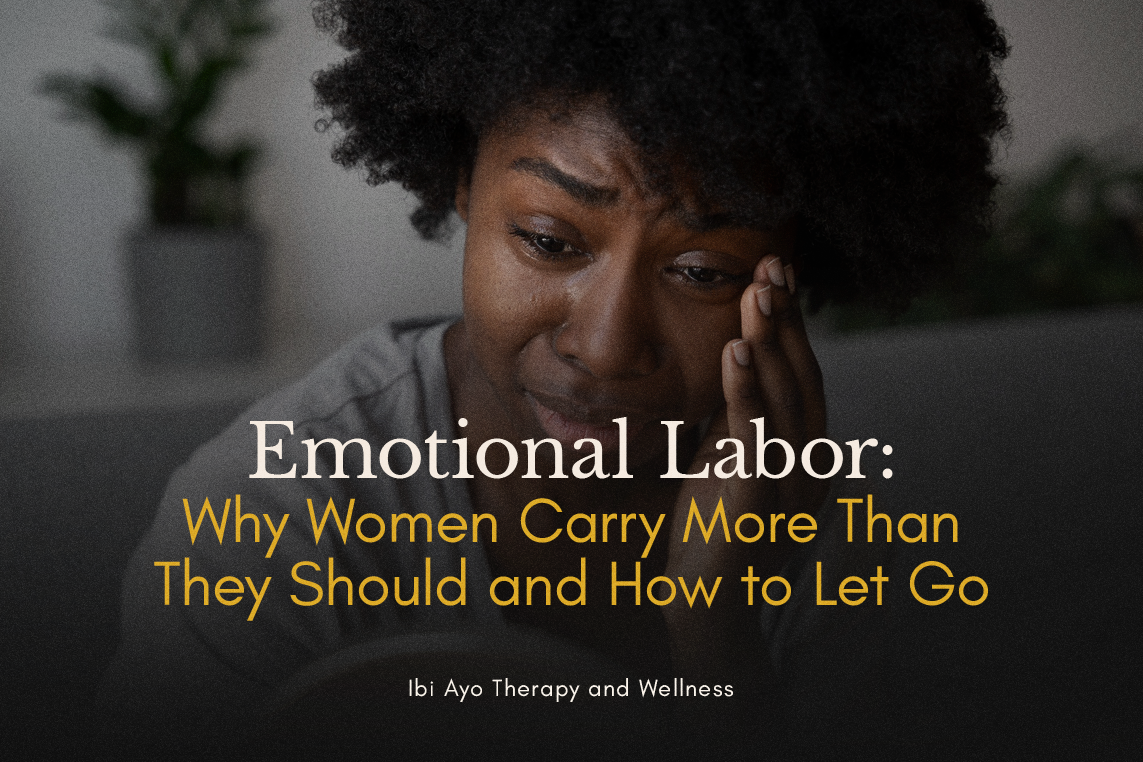
Emotional Labor: Why Women Carry More Than They Should and How to Let Go
"When was the last time someone asked how YOU were doing and actually waited for the answer?"
…I need you to sit with that question for a second.
Because if you’re the kind of woman who remembers everyone’s appointments, manages everyone’s feelings, smooths over every conflict, and still finds time to check in on everyone else, I see you.
And I want you to know that what you’re doing has a name.
It’s called emotional labor.
And it is exhausting.
We don’t talk about it enough. Not really.
Because when you do it well, nobody notices.
And when you stop? Suddenly everything falls apart, and somehow, that becomes your fault too.
So today, we’re going to talk about it. All of it.
So What Exactly Is Emotional Labor?
The term was coined by sociologist Arlie Hochschild in the 1980s, originally to describe the work of managing emotions as part of a job, think flight attendants staying calm and warm even when passengers are rude.
But over time, it’s evolved to describe something far more personal.
Emotional labor today is about all the invisible mental and emotional work involved in maintaining relationships, keeping the peace, and making other people feel seen and comfortable.
It’s the behind-the-scenes management of everyone else’s emotional world.
“Emotional labor is the invisible work of making sure everyone else is okay, even when you’re not.”
And here’s the thing, most of the time, nobody asks you to do it.
You just do.
Because somewhere along the line, you were taught that this is what good women do.
Good mothers. Good wives. Good friends. Good daughters. Good employees.
What Does It Actually Look Like?
Emotional labor doesn’t always look dramatic.
A lot of the time, it looks like an ordinary Tuesday
Noticing your partner is in a mood and mentally preparing how to manage it before they even say anything
Being the one who always remembers birthdays, buys the gifts, writes the cards, and plans the gatherings
Calming someone down after they’ve upset you, before your own feelings have even been acknowledged
Mediating between two people who could very well sort it out themselves, because you just can’t watch the tension
Saying “it’s fine” when it really, truly is not fine
Being the person everyone calls when things go wrong, even when you’re falling apart yourself
Thinking about what everyone else needs while your own needs sit quietly at the back of the queue
Sound familiar? I thought so.
And this isn’t a personality flaw, dear, it’s a pattern.
One that’s been deeply reinforced from childhood.
Why Do Women Carry So Much of This?

Let’s be honest about what’s really going on here.
Women aren’t just “naturally” more empathetic or nurturing.
We are socialized, from a very young age, to be emotionally responsible for others.
We’re taught to be agreeable.
To keep the peace.
To not make things awkward.
To put others first.
To be the soft landing for everyone around us.
And when we don’t?
We’re called difficult. Cold. Selfish. Emotional.
“Girls learn early that their value is tied to how well they take care of others. That lesson doesn’t just disappear when we grow up.”
It shows up in the workplace, where women are expected to mentor, mediate, and keep team morale high.
It shows up in relationships, where women often do the emotional heavy lifting of maintaining connection.
It shows up in families, where the woman is often the invisible glue holding everything and everyone together.
And the deeply frustrating part?
When a woman steps back from this role, people often don’t step up to fill it.
Things just fall apart.
Which then confirms the belief that she has to keep doing it.
What It’s Costing You
Carrying this much, for this long, takes a real toll.
And I don’t mean that in a vague, abstract way.
I mean it shows up in your body, your mood, your relationships, and your sense of self.
Here are the signs you’re carrying too much
You feel deeply resentful but don’t even know where to start explaining why
You’re exhausted even when you’ve had a full night’s sleep
You’ve forgotten what you actually want, because you’ve spent so long focused on what everyone else needs
You feel guilty any time you try to rest, say no, or put yourself first
You find yourself doing things for people while silently hoping they’ll notice and appreciate it, they often don’t
Your relationships feel one-sided, but you don’t know how to say it
This is burnout. Emotional burnout.
And it’s real, and it matters, and you are not being dramatic.
How to Begin Letting Go
Now, and this is the part I really want you to hear, letting go does not mean becoming cold, or selfish, or suddenly not caring about the people you love.
It means redistributing the weight.
It means letting others carry what they are more than capable of carrying.
Here’s where to start
Name it first.
Before you can change anything, you have to see it clearly.
Start paying attention to the moments when you take on something that wasn’t yours to take on.
Let the discomfort live with someone else for once.
When something is awkward or unresolved, resist the urge to fix it.
Let the other person feel it.
It’s not your job to make everything smooth.
Ask for what you need, directly.
Stop hinting.
Stop hoping people will notice.
Say it.
“I need support right now.”
“I’m overwhelmed.”
“I need you to take this off my plate.”
It feels vulnerable. Do it anyway.
Stop managing people’s reactions to your boundaries.
When you set a limit, you don’t owe anyone a soft landing.
Their disappointment is theirs to manage, not yours to absorb.
Redistribute, don’t abandon.
This is not about dropping everything.
It’s about having an honest conversation with the people in your life about the invisible work you’ve been doing, and asking them to share in it.
Get support for yourself.
Therapy is a powerful space to untangle why you keep picking up what others put down, and to start building a different relationship with your own needs.
You deserve that space too, dear.
You Are Not Responsible for Everyone’s Comfort
You can be a warm, loving, deeply caring woman, and still put your own wellbeing at the center of your life.
These things are not in conflict. They were never in conflict.
That was just the story you were handed. You are allowed to be taken care of too.
You are allowed to be held. You are allowed to let things be someone else’s problem. You are allowed to rest without earning it first.
References
Hochschild, A. R. (1983).
The managed heart: Commercialization of human feeling. University of California Press.
Hochschild, A. R. (2012).
The second shift: Working families and the revolution at home (Rev. ed.). Penguin Books.
Erickson, R. J. (2005).
Why emotion work matters: Sex, gender, and the division of household labor. Journal of Marriage and Family, 67(2), 337–351.
Offer, S., & Schneider, B. (2011).
Revisiting the gender gap in time-use patterns: Multitasking and well-being among mothers and fathers in dual-earner families. American Sociological Review, 76(6), 809–833.
Daminger, A. (2019).
The cognitive dimension of household labor. American Sociological Review, 84(4), 609–633.