
Not Just a Cartoon: What Inside Out Gets Right About Emotions and Mental Health
“Instead of resisting any emotion, the best way to dispel it is to enter it fully, embrace it and see through your resistance.” Deepak Chopra
Most of us do the opposite of this. We resist. We avoid. We tell ourselves we should not feel the way we feel. If sadness shows up, we try to fix it. If anger shows up, we hide it. If fear shows up, we call it weakness.
But emotions do not disappear just because you refuse to sit with them. They stay. They build. They show up in other ways. That is one reason Inside Out feels so real, even though it is a cartoon.
Not every emotion is meant to feel good
At first glance, the movie looks simple. Bright colors. Funny characters. A child adjusting to a new life. But underneath that story is something many adults still struggle to accept. Every emotion has a purpose, even the uncomfortable ones.
In real life, most people try to live like this:
Stay Positive
Stay Strong
Do not cry
Move on quickly
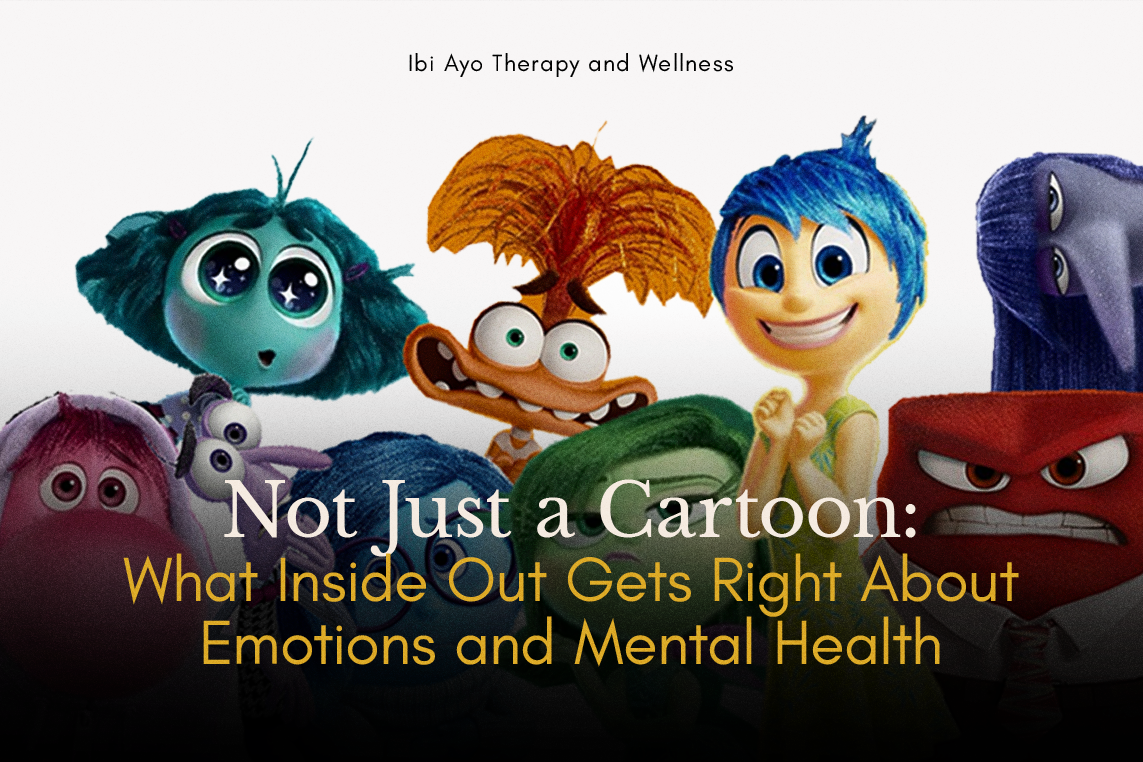
In the movie, Sadness keeps getting in the way, and Joy keeps trying to push her aside. To stay in control and keep things positive. It feels familiar because that is exactly what we try to do in reality.
But sadness has a role. It slows you down. It makes you notice what hurts. It makes you reach for support.
In therapy, people often realize the emotions they avoid the most are the ones trying to tell them something important.
You can feel more than one thing at the same time
One of the most realistic things the movie shows is that emotions are not neat or separate. You can feel different things at the same time, even when they seem to contradict each other.
For example, you can feel:
Happy but tired
Excited but scared
Grateful but overwhelmed
Love but still hurt
People often think this means something is wrong with them.
Most times, it means something real is happening.
Mixed emotions usually show up during:
Change
Loss
Growth
Uncertainty
The mind becomes complicated when life becomes complicated.
Change can shake your emotional balance
In the movie, everything starts to shift after Riley’s life changes. New environment. New routine. New expectations. She becomes distant, irritable, and withdrawn.
Not because she wants to be difficult.
Because her emotional balance is shaken.
This happens in real life more often than people admit.
Common triggers include:
Moving to a new place
Ending a relationship
Starting something new
Feeling pressure to adjust quickly
Losing something familiar
You think you are fine until you are not.
That does not mean you are weak.
It means your mind is trying to catch up with what has changed.
You are not meant to carry emotions alone
One of the strongest moments in the movie is when Riley stops pretending she is okay. She cries. She tells the truth about how she feels. Nothing magical happens, but something shifts.
She is no longer alone inside her own head.
That is how emotions work:
They become heavier when you resist them
They become clearer when you allow yourself to feel them
They become easier when you talk about them
This is one of the reasons therapy can help. Not because emotions should disappear, but because they make more sense when you are not facing them alone.
Conclusion
Inside Out may look like a children’s movie, but the message is very real. You do not get better by avoiding emotions. You get better by understanding them and embracing them.
Sometimes the hardest thing to do is to stay with what you feel. Sometimes that is exactly what you need.
References
Chopra, D. (2007). The Book of Secrets: Unlocking the Hidden Dimensions of Your Life. Harmony Books.
Ekman, P. (2003). Emotions Revealed: Recognizing Faces and Feelings to Improve Communication and Emotional Life. New York: Times Books.
Gross, J. J. (1998). The emerging field of emotion regulation: An integrative review. Review of General Psychology, 2(3), 271–299.
Inside Out. Directed by Pete Docter. Pixar Animation Studios / Walt Disney Pictures.
Siegel, D. J. (2012). The Developing Mind: How Relationships and the Brain Interact to Shape Who We Are. New York: Guilford Press.